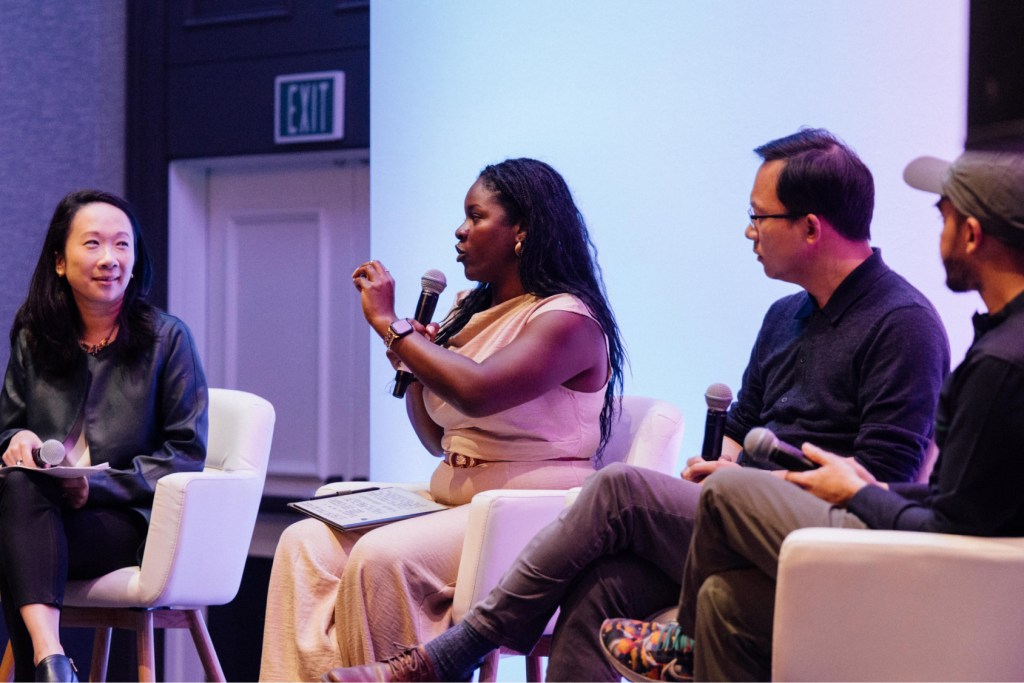
Learning Commons will join educators, researchers, and innovators at the 2026 ASU+GSV Summit, The Power of Fusion, held April 12-15 in San Diego, to discuss the future of learning and the need for more education technology tools that better connect the way students learn to the tools they learn with. Learning Commons staff will participate in panels across the AI and K-12 tracks.
Sessions at ASU+GSV
Raising the Bar: Building Quality, Trust, and Learning Science into AI Education Tools
Tuesday, April 14, 10:10–10:50 AM PT — Harbor E
Sandra Liu Huang, President of Learning Commons, will join a panel conversation on how thoughtful design, transparency, and alignment with learning science can distinguish genuinely transformative tools from those that merely automate existing practices or add to classroom clutter. The session will challenge the edtech sector to prioritize pedagogical integrity and user agency over rapid deployment, setting a higher standard for what belongs in educators’ and students’ essential toolkit.
The Human-AI Partnership in Education Data: Why Discernment Makes Intelligence Actionable
Tuesday, April 14, 3:00–3:50 PM PT — America’s Cup, Level 4
Tyler Sussman, Director, Philanthropic Strategy and Partnerships at Learning Commons, will join other leaders working at the intersection of education and data to examine how AI, generative AI, and machine learning expand analytical capacity and accelerate insight—while deploying human discernment to ask the right questions, interpret outputs, and turn intelligence into action. This session will explore how leaders working across high-quality materials and assessments are viewing both supply and demand actors integrating human and AI efforts to build, implement, and measure the quality of the strongest tools for students.
Is AI Eliminating Productive Struggle — and With It… Learning?
Tuesday, April 14, 3:50–4:30 PM PT — K–12 Track
Vice President of Product Kristin Vincent will moderate a discussion exploring how “productive struggle” shows up in an AI-assisted learning environment, and where the line lies between meaningful support and cognitive shortcutting. The conversation examines what rigor really means when students have access to instant feedback, hints, and solutions. Bringing together perspectives from learning science, instructional design, classroom practice, and education technology, this session offers a grounded look at how AI can be used intentionally: not to replace thinking, but to deepen it.
What is Creativity and Learning in the Age of AI?
Wednesday, April 15, 10:10–10:50 AM PT — Harbor H, Level 2
Dan Quine, Senior Director of Engineering and AI at Learning Commons, will moderate a panel examining what happens to mastery when output is abundant — and how professional creators evolve in a world of infinite generation. AI can now draft marketing copy, design graphics, generate video avatars, remix audio, and simulate entire creative workflows. But when creation becomes frictionless, what changes? This session explores how AI is reshaping authorship and ownership, whether prompting is the new creative skill, and the rise of direction, taste, and curation as core competencies.
###
Launched in 2025, Learning Commons builds on the Chan Zuckerberg Initiative’s decade of work advancing learning science and translating research into classroom practice. Through shared, open technological infrastructure built for the public good, Learning Commons aims to better connect the way students learn with the tools they use.