
About RightOn!
RightOn! is an online math platform built on a simple but powerful premise: student mistakes reveal how students are thinking and serve as the foundation for error-based learning. Through live classroom games, RightOn! gives teachers real-time insight into student reasoning, including confidence ratings and reflection prompts, and provides students fast, personalized feedback that helps them persist and learn from mistakes. The platform fosters self-efficacy, persistence, and growth mindsets, all key drivers of how students engage more deeply with math and develop conceptual understanding.
Teachers use RightOn! to quickly launch math games, either from a library of ready-to-use content or their own, and guide students as they respond, reflect, and discuss in real time. As students and teachers engage regularly, this helps build a classroom culture where getting something wrong is the beginning of understanding, not the end.
Building on this foundation, RightOn! is now developing MicroCoach, an AI-powered tool that helps teachers identify patterns in student thinking and turn them into targeted instructional next steps before the next lesson.
The problem: Teachers had the data but what they needed was a map
RightOn! has rich, classroom-based data on how students think. For example, a teacher might see that many students confidently chose the same incorrect answer, which signals a shared misconception rather than a simple mistake. During each session, teachers can see which questions students missed, how confident they were in their answers, and even how students reflected on their own reasoning.
But data alone doesn’t tell a teacher what to do on any given day in the classroom.
Early-career teachers in particular struggled to move from noticing patterns in student errors to knowing what to do about them. Was a common wrong answer a surface-level slip, or a signal of a deeper conceptual misconception? Would re-teaching the concept support students’ progress or slow it down by interrupting carefully sequenced instruction? And how did any of this connect to what students needed to be ready for next?
Without visibility into the conceptual relationships between topics, the prerequisite skills, the learning progressions, and the pedagogical throughlines, it was hard to answer these questions with confidence. As a result, teachers sometimes retaught content students were ready to move past, or moved forward without addressing gaps that would compound later.
Internally, RightOn!’s team faced a parallel challenge: generating AI-powered recommendations grounded in learning science and aligned with research-backed learning progressions, not just surface-level performance trends.
The solution: Recommendations rooted in learning science research
RightOn! began exploring the Learning Commons Knowledge Graph as a way to ground its AI reasoning in structured, evidence-backed representations of how math concepts connect and build on one another.
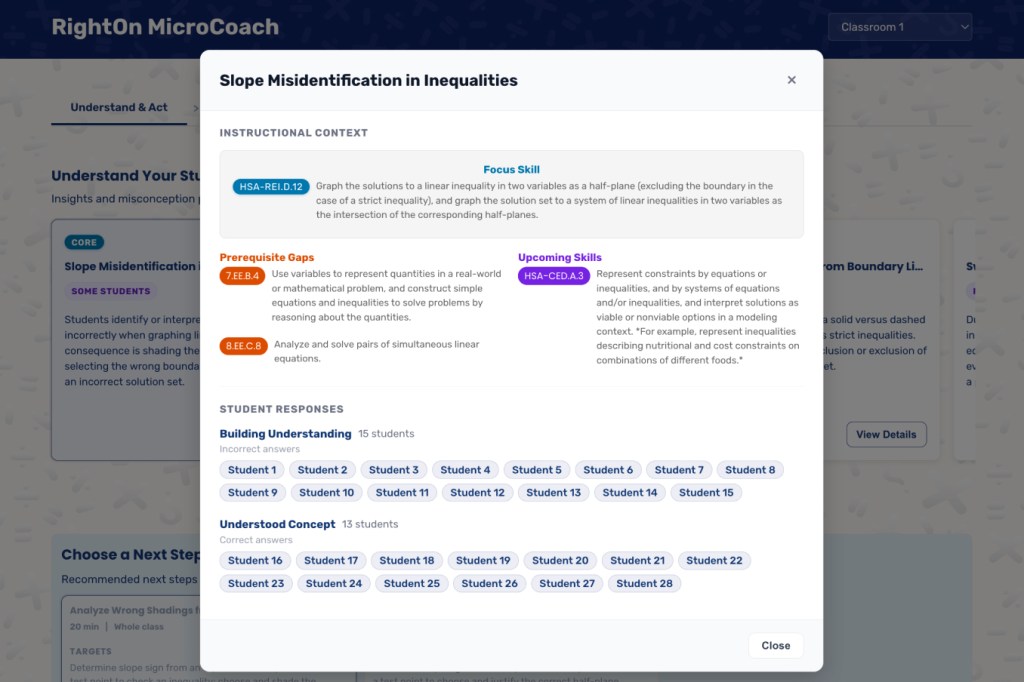
The integration works by mapping student response patterns, including confidence ratings and reflection data about student reasoning, against the Knowledge Graph’s representation of conceptual dependencies and learning progressions. Rather than surfacing recommendations based solely on aggregated correctness, MicroCoach uses the Knowledge Graph to interpret why students may be making particular errors and where that fits within a broader learning trajectory.
This makes it possible to distinguish, for example, between a misconception rooted in a foundational gap (which may need to be addressed before moving forward) and a surface-level error that targeted feedback can quickly resolve. It also enables differentiated instructional recommendations: next steps based on core and secondary misconceptions that reflect the range of needs within a classroom, not just the average.
Crucially, the goal isn’t to replace teacher judgment. MicroCoach is designed as a teacher-in-the-loop tool that balances ease of use with teacher judgment and agency. RightOn! is actively exploring how to surface just the right slice of the Knowledge Graph, enough to give teachers a clear pedagogical throughline without overwhelming them with complexity.
Early evidence of impact
RightOn! is currently piloting MicroCoach with math teachers from multiple schools and early testing with existing data demonstrates a shift in recommendations when Knowledge Graph data is in the loop.
The difference shows up in specificity. Without the Knowledge Graph, a recommendation might tell a teacher: “Your students need help with adding and subtracting decimals.” But with it, MicroCoach can situate that knowledge gap within a learning progression, clearly surfacing whether the misconception is rooted in a prerequisite concept students haven’t yet learned or a bridge concept that strengthens upcoming learning. The Knowledge Graph’s structured representation of learning progressions, conceptual dependencies, and academic standards are drawn from sources including Student Achievement Partners’ Coherence Map and ANet’s K–12 math learning components, which gives that recommendation a clear pedagogical throughline.
RightOn! is also developing an efficacy framework to measure impact, including follow-up assessments designed to capture both math proficiency and students’ willingness to persist through challenging problems.
Why it matters
The Learning Commons Knowledge Graph is a structured collection of datasets that connects academic standards, learning progressions, and learning science research in a unified, machine-readable format. For an AI reasoning system like MicroCoach, this structure is what allows a pattern in student responses to become a pedagogically grounded recommendation, one that accounts for where a concept sits in a sequence of learning, how it connects to what came before, and what it makes possible next.
For teachers, that translates into something concrete: the ability to look at a set of student errors and know, with confidence, whether to re-teach, bridge, or move forward, and why. Early-career teachers in particular report that this kind of structured support makes the difference between assessment data that sits unused and data that actually shapes instruction.
This is the reinforcing dynamic RightOn! is building toward: when teachers can act on student thinking with confidence, students experience a classroom where mistakes are expected and respected and used as opportunities to strengthen their reasoning.
Learning Commons provides the infrastructure that makes this possible: open, research-aligned, and designed to be integrated directly into the AI tools that reach classrooms every day.