Use case: If you’ve already aligned content to one state’s academic standards, and you’re expanding into new states without rebuilding that alignment from scratch or introducing mismatches.
Your product has content, generated by AI, licensed, or built by your own team, that is already aligned to one state’s framework. Expanding to a second state means someone finds the equivalent standard, checks whether the wording and grade placement actually match, and repeats that process for every standard in your library. It’s tedious, and a missed nuance, such as a Learning Component (a standard’s underlying skill) that lands in Grade 4 in one state and Grade 5 in another, can quietly misalign content for an entire new market.
This gets more expensive with each state you add. Two states rarely phrase the same academic standard identically, and manual crosswalking doesn’t scale linearly. Each new state has to be checked against every state already in your library, so the work compounds.
How Learning Commons helps
Send in a standard you’re already aligned to, and Knowledge Graph returns its equivalent in another state’s framework, matched through the same underlying Learning Component rather than a manual side-by-side read. You can extend an existing alignment to a new state in one call, or query across states directly to see exactly where two frameworks agree and where they diverge, in grade placement, scope, or phrasing, before you commit content to either one.
Datasets in Knowledge Graph include:
- Academic Standards map a standard to its authoritative statement, sourced through Common Good Learning Tools‘s CASE data across all 50 U.S. states and core subjects
- Learning Components break a standard into the granular skills and concepts underneath it, currently available for mathematics across all grades, and for ELA in grades K-2 so far
- Learning Progressions sequence academic standards into what comes before and after a given skill, currently available for math
- Standards Crosswalks map an academic standard to its equivalent in another state’s framework, currently available for math
- Curriculum aligns your content to real classroom materials like Illustrative Mathematics, available on a gated basis
How it works
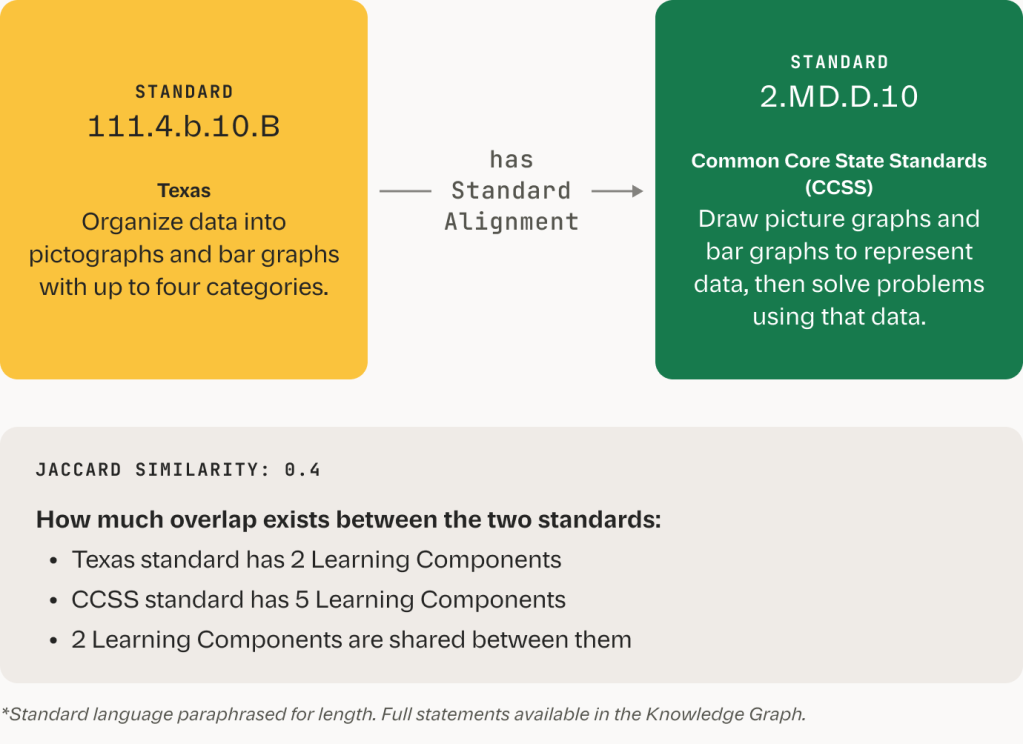
What you can do with this
- Extend an existing standard aligned to Common Core (CCSS) to a new state by resolving equivalents, rather than rebuilding alignment logic from scratch.
- Query how Common Core (CCSS) and a specific state treat the same academic standard side by side, useful when scoping a multiple state project.
- Catch grade-placement or scope mismatches automatically, where the same Learning Component lands in a different grade or is defined more narrowly in a new state.
- Prioritize which states to expand into next based on how closely their academic standards crosswalk to states you already support.