Use case: If your product intends to supplement a specific curriculum, and AI-generated content needs to align to that curriculum.
Your product generates AI content for end users. But if your content is meant to supplement a core curriculum like Illustrative Mathematics and isn’t tied back to the actual units and lessons in that curriculum, it’ll miss targeting the specific learning goals. For example, your product generates a worksheet to supplement a lesson on fractions. It might be technically correct and still miss the specific diagram, vocabulary, or sequencing that lesson 7 of unit 4 already established.
The mismatch is easy to miss internally. Your content can be standards-aligned and still feel disconnected, because standards alignment tells you what a state expects, not what a specific curriculum already taught the student two lessons ago. A teacher using that curriculum notices immediately.
How Learning Commons helps
Query a curriculum, unit, and lesson, and Knowledge Graph returns what that lesson is built from: the standard it addresses, the terms and models it introduces, and where it sits in the curriculum’s own sequence. Your AI can generate content that picks up exactly where that lesson left off, instead of reconstructing the curriculum’s structure from scratch.
Datasets in Knowledge Graph include:
- Academic Standards map a standard to its authoritative statement, sourced through Common Good Learning Tools‘s CASE data across all 50 U.S. states and core subjects
- Learning Components break a standard into the granular skills and concepts underneath it, currently available for mathematics across all grades, and for ELA in grades K-2 so far
- Learning Progressions sequence academic standards into what comes before and after a given skill, currently available for math
- Standards Crosswalks map an academic standard to its equivalent in another state’s framework, currently available for math
- Curriculum aligns your content to real classroom materials like Illustrative Mathematics, available on a gated basis
How it works
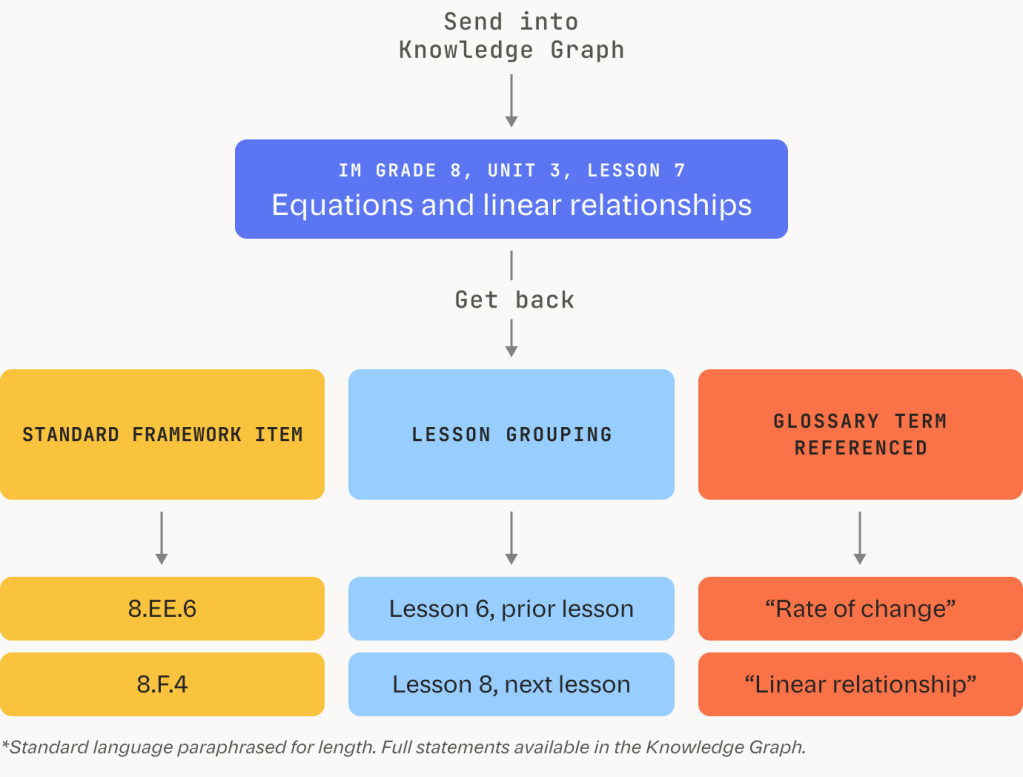
What you can do with this
- Sequence new content to follow a specific lesson rather than a general standard, so it picks up exactly where that lesson left off.
- Check whether a piece of generated content assumes a term or method a specific lesson hasn’t introduced yet, before it reaches a student.
- Support multiple curricula from one integration, since curriculum is a parameter rather than something you rebuild per partner.