Use case: If your product generates AI content continuously, and you need to catch shifts in output quality over time.
Your product generates reading passages, explanations, or feedback for students. The quality of that content does not stay static — model updates, prompt changes, and shifts in input patterns can all cause grade-level appropriateness or vocabulary complexity to drift over time. The shift is gradual. No single output looks obviously wrong.
Consider this scenario: your product has been generating Grade 6 science passages stably for months. Then your LLM provider ships a model update. Nothing breaks, but over the following weeks, the average grade band of your outputs shifts from “6–7” to “8–9.” Without a systematic monitor, the only way to catch the drift is for a teacher to flag it, which means it has already reached students.
How Learning Commons helps
Route a sample of production outputs through Evaluators on a schedule – weekly, monthly, or continuously – depending on your risk tolerance, and track the scores as a trend instead of a one-off read. When the distribution shifts outside your threshold, you get a documented signal to investigate before the problem reaches students at scale, in language teachers and curriculum leaders already trust.
Available today:
- Text Complexity Evaluators assess text complexity dimensions including grade-level appropriateness, vocabulary, and subject matter knowledge, grounded in the SAP Qualitative Text Complexity rubric
- Feedback Evaluators assess the quality of AI-generated coaching feedback on student writing, currently validated for grades 8-9 and a specific task type
- Academic Standards Evaluators currently include Math Alignment, which judges whether a math question aligns to a supported state jurisdiction’s standards
- Durable Skills Evaluators assess skills like critical thinking through student writing, grounded in the Carnegie and ETS Skills Progressions framework
Each Evaluator returns a score and reasoning for every output you run through it. More evaluator families are in active development. See the current catalog and output format in the docs
How it works
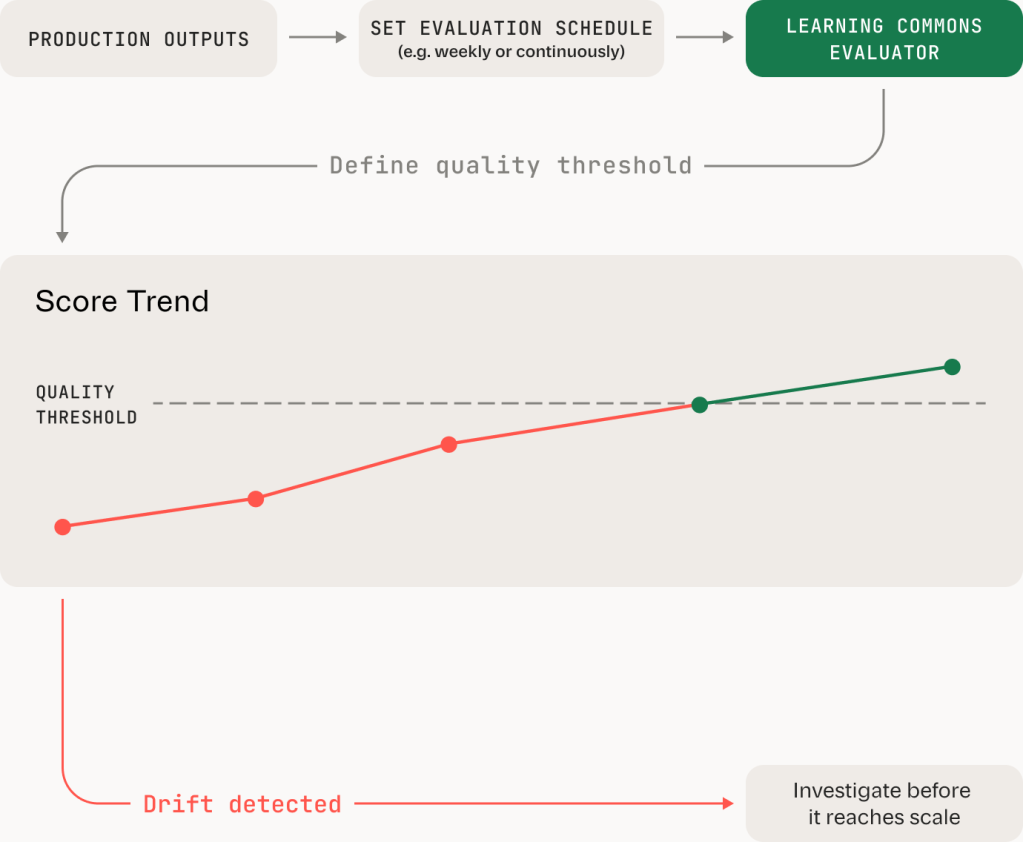
What you can do with this
- Establish a scored baseline on a representative sample before any model, prompt, or infrastructure change, so you have something to compare against.
- Run Evaluators on a scheduled sample and track grade band and complexity distributions week over week.
- Watch Tier 3 vocabulary frequency as an early signal. It often shifts before grade-band scores do, giving you more time to investigate.
- Correlate score changes with model updates or prompt changes to find the root cause faster.
- Set tighter monitoring thresholds for younger grades and independent reading, and wider ones for teacher-facing materials.