Use case: If your product generates AI content at scale and you need every output checked and fixed automatically before it ships.
Your product generates AI content for end users. Ask the same AI the same question twice and you can get two different answers. The same prompt can produce a passage that’s within grade band one run, and one that isn’t the next, with no code change and no warning. Without a check built into the pipeline, the only options are manual review or shipping without one. Manual review can’t keep pace with automated generation, and skipping it means inconsistencies get through.
The inconsistency is harder to see than you might expect. The same prompt, run twice, can return a Grade 4 passage and a Grade 6 passage, not because the prompt changed, but because language models are probabilistic. One run produces sentences that are short and direct. The next wraps the same information in subordinate clauses and Tier 3 vocabulary a Grade 4 student has never encountered. Both look like reasonable outputs. Only one is appropriate for your students. Without a check built into the pipeline, there is no systematic way to tell them apart before they ship.
How Learning Commons helps
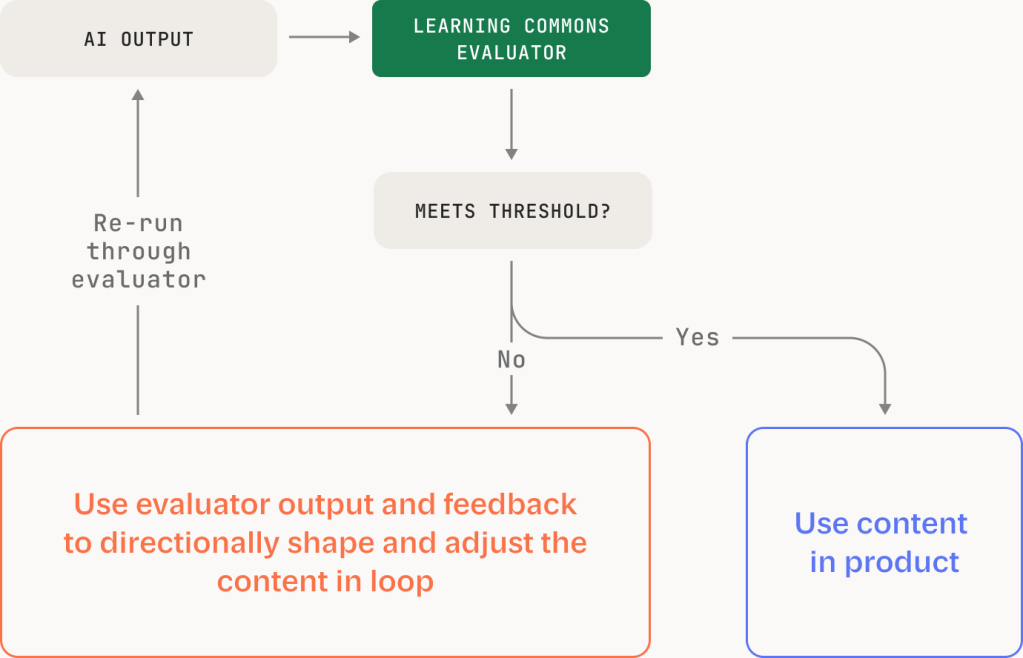
Build Evaluators into your generation pipeline, and every output gets scored against a research-backed quality rubric before it reaches a student. If an output misses your grade-level threshold, the pipeline uses Evaluator’s reasoning and word list as constraints for a rewrite, then checks it again, all before it ships, in language teachers and curriculum leaders already trust. This check can run automatically in your pipeline, or be surfaced as an on-demand action for a teacher to trigger and read the result directly.
Available today:
- Text Complexity Evaluators assess text complexity dimensions including grade-level appropriateness, vocabulary, and subject matter knowledge, grounded in the SAP Qualitative Text Complexity rubric
- Feedback Evaluators assess the quality of AI-generated coaching feedback on student writing, currently validated for grades 8-9 and a specific task type
- Academic Standards Evaluators currently include Math Alignment, which judges whether a math question aligns to a supported state jurisdiction’s standards
- Durable Skills Evaluators assess skills like critical thinking through student writing, grounded in the Carnegie and ETS Skills Progressions framework
Each Evaluator returns a score and reasoning for every output you run through it. More evaluator families are in active development. See the current catalog and output format in the docs
How it works
What you can do with this
- Gate every output on grade level before it reaches a student. No human review step required for routine quality control.
- Pass the complex word list and Evaluator reasoning back to your LLM as rewrite constraints, so the revision targets exactly what failed.
- Set different thresholds per content type. Stricter for independent student reading, wider for teacher-facing materials.
- Log outputs that needed a rewrite over time to see whether your base prompt needs a structural fix.
- Surface the same check as an “Evaluate” action in a teacher-facing UI, returning a plain-language result instead of a raw score.
- Let a teacher adjust the target grade and re-run, useful for differentiating one passage across a mixed classroom.