
About Glimmer
Glimmer is an AI math platform built on a conviction its co-founders hold, based on firsthand experience: the difference between a student who struggles and a student who thrives is often one conversation. Co-founder Glory knows this personally. As a seventh-grader struggling with math, she didn’t start to thrive until a teacher sat down with her, figured out where she was stuck, and worked through it with her one-on-one. She went on to join the math team and study engineering. Now, with Glimmer, she’s devoting her career to giving every student that same kind of attention.
Co-founder Neel came at it from the other side of the desk. After studying computer science and education at Stanford and teaching with Teach for America in San Francisco, he ran into a related gap: the data he had as a teacher could tell him what a student missed, but rarely what they didn’t understand, or why. His richest diagnostic was always a conversation, asking a student to walk through their thinking until he could see where it broke down.
Glimmer’s student-facing AI, called Glo, is built to have that conversation at scale. Glo tutors students through math problems in real time, asking probing questions, surfacing their strategies, and identifying both developing understanding and emerging misunderstandings. Teachers get a live view into how their students are thinking, not just what they got wrong, so they can step in with precision when it matters.
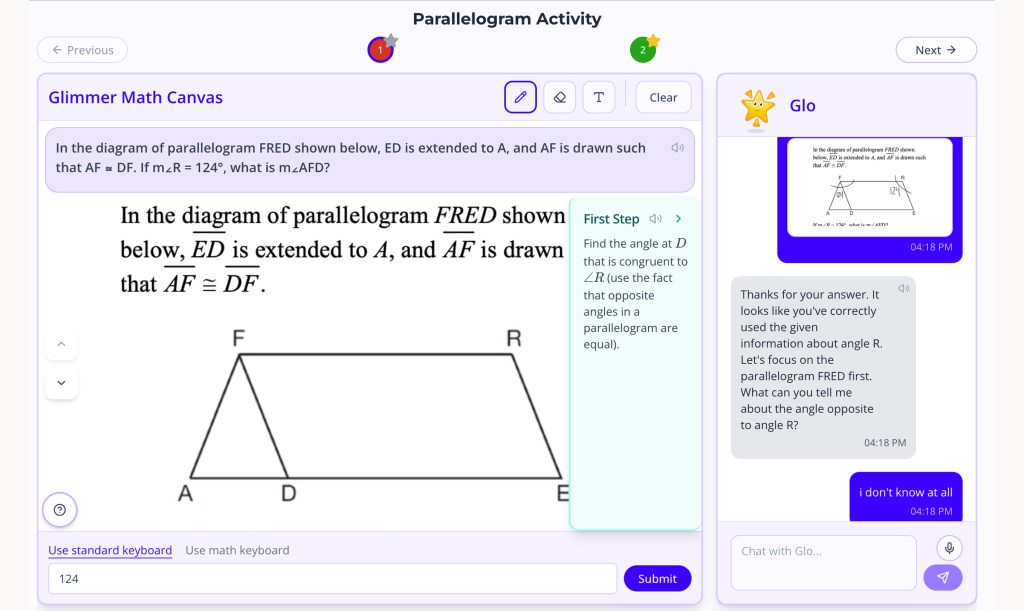
The problem: Good AI tutoring requires knowing how math fits together
Building an AI math tutor that can actually move students forward takes more than a capable large language model. Out of the box, LLMs don’t know how mathematical concepts build on one another: which prerequisites underlie a given skill, which misconceptions tend to emerge at each stage, and how a small gap in one concept can compound into real confusion several steps later. That’s pedagogical content knowledge, and it’s exactly what a strong math teacher spends years developing.
Neel puts it this way: “A teacher and Glo both need content knowledge. They both need to really understand how the math works. They also both need the pedagogical knowledge of how to build conceptual understanding and elicit student thinking. And to put it all together, they need the pedagogical content knowledge, a sense of how the underlying structure of the math and the pedagogy intersect.”
For Glimmer, ensuring Glo understood how math fit together meant getting deep into state standards and curricular progressions. The team had committed to serving students across multiple states, each with its own frameworks. Mapping K–12 academic math standards from scratch across all of those contexts, and then maintaining them, would have been a massive lift on top of everything else they were building.
The solution: Grounding Glo in the structure of math itself
Just as a teacher develops a sense of how skills build on each other before they can diagnose where a student is stuck, Glo needed a structured map of how math concepts fit together. Glimmer integrated the Learning Commons Knowledge Graph before launching its product, pulling in the Academic State Standards dataset and math learning components, which are the finer-grained skills and concepts underneath each academic standard. The result was a machine-readable map of how math concepts connect and progress from foundational skills through grade-level academic standards, aligned across state contexts.
As Glory put it: “We were going to have to build our own knowledge graph. That was the game plan. But the reality is, it would have been really tough, and probably not nearly as accurate. Yours is research-backed. And it saved us a lot of time and allowed us to do right by kids and teachers more quickly.”
The technical savings matter, but the bigger payoff is what the Knowledge Graph makes possible for students and teachers. Glimmer uses the Knowledge Graph to build a unique map of academic standards and learning components for each student, tracking mastery at a fine-grained level. That lets Glo pinpoint where a student is stuck. And because Glimmer can see patterns across many students and states, it can surface which learning components tend to be the most difficult and which ones most strongly predict success later, so teachers know where to spend their attention.
Great math teachers don’t just know which concepts are hard. They know why they’re hard, and how a student’s misunderstanding is likely to show up in their work. Glimmer built that same instinct into Glo. On top of the Knowledge Graph, they layered hypotheses about the common errors students make at each learning component. Then they let those hypotheses keep learning, refining, and expanding based on what Glo sees in real conversations with students.
Early evidence: Students are staying in the conversation
Glimmer is still in its early days, but teachers and students are already responding. In a survey of an eighth-grade class at a Bronx school piloting the tool, 20 of 21 students said Glo had helped them learn math that week. Students in a California school are even asking their teacher to upload problems into Glimmer and lobbying their principal to bring it back the following year.
What stands out most is the depth of engagement. Students are having real back-and-forth exchanges with Glo — they’re sitting with confusion, asking follow-up questions, and building understanding with growing independence.
Teachers are getting new visibility, too. One described a typically quiet student, who rarely asked questions in class, now having rich conversations with Glo, the kind of conversations that show both what the student understands and where they’re stuck, which enriches the conversation when the teacher steps in.
Why it matters
Glo can meet a student where they are and help a teacher understand why a student is struggling, rather than just that they are, because of something most AI tutors lack: a structured, research-aligned map of how mathematical understanding develops. Without that map, an AI can flag a wrong answer but not explain what it means or what to do about it.
The Knowledge Graph provides that foundation. It’s open, machine-readable, and designed to be integrated directly into the AI tools reaching classrooms today. For Glimmer, it’s the difference between a tutor who says “try again” and one who can trace a misconception back to its root, identify the prerequisite concept a student hasn’t yet mastered, and keep them in the conversation long enough for understanding to form.
Glimmer is a build partner of Learning Commons, integrating the Knowledge Graph, including Academic State Standards and Math Learning Components, into Glo to power research-grounded, personalized math tutoring for K–12 students.